 Add to Chrome
 Add to Firefox
 Add to Edge
SkillRevise: Improving LLM-Authored Agent Skills via Trace-Conditioned Skill Revision
May 31, 2026
Agent skills are procedural artifacts that enable LLM agents to execute workflows, verify constraints, and recover from failures. Existing self-evolving methods refine skills using accumulated trajectories. However, they struggle in cold-start settings, where only an initial, imperfect skill is available. Consequently, skill construction defaults to expert authoring or one-shot LLM generation. Expert-authored skills are costly and may not align with how LLM agents actually execute tasks, while one-shot generated skills can be syntactically well formed yet behaviorally weak. To bridge this gap, we propose SkillRevise, an execution-grounded framework designed to iteratively refine these initial skills. SkillRevise diagnoses skill defects from execution evidence, retrieves relevant repair principles from a general memory, and applies execution-anchored edits. By re-executing candidates and measuring empirical utility, it systematically retains the optimal skill version. Evaluated across three benchmarks and five LLMs, SkillRevise substantially outperforms one-shot baselines, improving the base agent's success rate on SkillsBench from 36.05% to 61.63%. Furthermore, the revised skills exhibit strong cross-model transferability, capturing generalized procedural knowledge over model-specific artifacts.

The MiniMax-M2 Series: Mini Activations Unleashing Max Real-World Intelligence
May 26, 2026We introduce the MiniMax-M2 series, a family of Mixture-of-Experts language models built around the principle that mini activations can unleash maximum real-world intelligence. The flagship M2 contains 229.9B total parameters with only 9.8B activated per token. Designed end-to-end for agentic deployment, the M2 series rests on three components: (i) agent-driven data pipelines producing large-scale, verifiable trajectories across agentic coding and agentic cowork, each grounded in an executable workspace and an artifact-aligned reward; (ii) Forge, a scalable agent-native RL system that adapts to long-horizon agent trajectories, paired with windowed-FIFO scheduling, prefix-tree merging, inference optimization, and a clean training-inference-agent decoupling that supports both white-box and black-box agents; (iii) the latest M2.7 checkpoint takes an early step toward self-evolution -- autonomously debugging training runs and modifying its own scaffold. Across M2 through M2.7, this combination translates a mini-activation footprint into frontier-tier performance on agentic coding, deep search, office-task, and reasoning benchmarks.
Towards On-Policy Data Evolution for Visual-Native Multimodal Deep Search Agents
May 11, 2026Multimodal deep search requires an agent to solve open-world problems by chaining search, tool use, and visual reasoning over evolving textual and visual context. Two bottlenecks limit current systems. First, existing tool-use harnesses treat images returned by search, browsing, or transformation as transient outputs, so intermediate visual evidence cannot be re-consumed by later tools. Second, training data is usually built by fixed curation recipes that cannot track the target agent's evolving capability. To address these challenges, we first introduce a visual-native agent harness centered on an image bank reference protocol, which registers every tool-returned image as an addressable reference and makes intermediate visual evidence reusable by later tools. On top of this harness, On-policy Data Evolution (ODE) runs a closed-loop data generator that refines itself across rounds from rollouts of the policy being trained. This per-round refinement makes each round's data target what the current policy still needs to learn. The same framework supports both diverse supervised fine-tuning data and policy-aware reinforcement learning data curation, covering the full training lifecycle of the target agent. Across 8 multimodal deep search benchmarks, ODE improves the Qwen3-VL-8B agent from 24.9% to 39.0% on average, surpassing Gemini-2.5 Pro in standard agent-workflow setting (37.9%). At 30B, ODE raises the average score from 30.6% to 41.5%. Further analyses validate the effectiveness of image-bank reuse, especially on complex tasks requiring iterative visual refinement, while rollout-feedback evolution yields more grounded SFT traces and better policy-matched RL tasks than static synthesis.
XSkill: Continual Learning from Experience and Skills in Multimodal Agents
Mar 12, 2026Multimodal agents can now tackle complex reasoning tasks with diverse tools, yet they still suffer from inefficient tool use and inflexible orchestration in open-ended settings. A central challenge is enabling such agents to continually improve without parameter updates by learning from past trajectories. We identify two complementary forms of reusable knowledge essential for this goal: experiences, providing concise action-level guidance for tool selection and decision making, and skills, providing structured task-level guidance for planning and tool use. To this end, we propose XSkill, a dual-stream framework for continual learning from experience and skills in multimodal agents. XSkill grounds both knowledge extraction and retrieval in visual observations. During accumulation, XSkill distills and consolidates experiences and skills from multi-path rollouts via visually grounded summarization and cross-rollout critique. During inference, it retrieves and adapts this knowledge to the current visual context and feeds usage history back into accumulation to form a continual learning loop. Evaluated on five benchmarks across diverse domains with four backbone models, XSkill consistently and substantially outperforms both tool-only and learning-based baselines. Further analysis reveals that the two knowledge streams play complementary roles in influencing the reasoning behaviors of agents and show superior zero-shot generalization.
AgentVista: Evaluating Multimodal Agents in Ultra-Challenging Realistic Visual Scenarios
Feb 26, 2026Real-world multimodal agents solve multi-step workflows grounded in visual evidence. For example, an agent can troubleshoot a device by linking a wiring photo to a schematic and validating the fix with online documentation, or plan a trip by interpreting a transit map and checking schedules under routing constraints. However, existing multimodal benchmarks mainly evaluate single-turn visual reasoning or specific tool skills, and they do not fully capture the realism, visual subtlety, and long-horizon tool use that practical agents require. We introduce AgentVista, a benchmark for generalist multimodal agents that spans 25 sub-domains across 7 categories, pairing realistic and detail-rich visual scenarios with natural hybrid tool use. Tasks require long-horizon tool interactions across modalities, including web search, image search, page navigation, and code-based operations for both image processing and general programming. Comprehensive evaluation of state-of-the-art models exposes significant gaps in their ability to carry out long-horizon multimodal tool use. Even the best model in our evaluation, Gemini-3-Pro with tools, achieves only 27.3% overall accuracy, and hard instances can require more than 25 tool-calling turns. We expect AgentVista to accelerate the development of more capable and reliable multimodal agents for realistic and ultra-challenging problem solving.
Kimi K2.5: Visual Agentic Intelligence
Feb 02, 2026We introduce Kimi K2.5, an open-source multimodal agentic model designed to advance general agentic intelligence. K2.5 emphasizes the joint optimization of text and vision so that two modalities enhance each other. This includes a series of techniques such as joint text-vision pre-training, zero-vision SFT, and joint text-vision reinforcement learning. Building on this multimodal foundation, K2.5 introduces Agent Swarm, a self-directed parallel agent orchestration framework that dynamically decomposes complex tasks into heterogeneous sub-problems and executes them concurrently. Extensive evaluations show that Kimi K2.5 achieves state-of-the-art results across various domains including coding, vision, reasoning, and agentic tasks. Agent Swarm also reduces latency by up to $4.5\times$ over single-agent baselines. We release the post-trained Kimi K2.5 model checkpoint to facilitate future research and real-world applications of agentic intelligence.
The Tool Decathlon: Benchmarking Language Agents for Diverse, Realistic, and Long-Horizon Task Execution
Oct 29, 2025Real-world language agents must handle complex, multi-step workflows across diverse Apps. For instance, an agent may manage emails by coordinating with calendars and file systems, or monitor a production database to detect anomalies and generate reports following an operating manual. However, existing language agent benchmarks often focus on narrow domains or simplified tasks that lack the diversity, realism, and long-horizon complexity required to evaluate agents' real-world performance. To address this gap, we introduce the Tool Decathlon (dubbed as Toolathlon), a benchmark for language agents offering diverse Apps and tools, realistic environment setup, and reliable execution-based evaluation. Toolathlon spans 32 software applications and 604 tools, ranging from everyday platforms such as Google Calendar and Notion to professional ones like WooCommerce, Kubernetes, and BigQuery. Most of the tools are based on a high-quality set of Model Context Protocol (MCP) servers that we may have revised or implemented ourselves. Unlike prior works, which primarily ensure functional realism but offer limited environment state diversity, we provide realistic initial environment states from real software, such as Canvas courses with dozens of students or real financial spreadsheets. This benchmark includes 108 manually sourced or crafted tasks in total, requiring interacting with multiple Apps over around 20 turns on average to complete. Each task is strictly verifiable through dedicated evaluation scripts. Comprehensive evaluation of SOTA models highlights their significant shortcomings: the best-performing model, Claude-4.5-Sonnet, achieves only a 38.6% success rate with 20.2 tool calling turns on average, while the top open-weights model DeepSeek-V3.2-Exp reaches 20.1%. We expect Toolathlon to drive the development of more capable language agents for real-world, long-horizon task execution.
GRACE: Generative Representation Learning via Contrastive Policy Optimization
Oct 06, 2025Prevailing methods for training Large Language Models (LLMs) as text encoders rely on contrastive losses that treat the model as a black box function, discarding its generative and reasoning capabilities in favor of static embeddings. We introduce GRACE (Generative Representation Learning via Contrastive Policy Optimization), a novel framework that reimagines contrastive signals not as losses to be minimized, but as rewards that guide a generative policy. In GRACE, the LLM acts as a policy that produces explicit, human-interpretable rationales--structured natural language explanations of its semantic understanding. These rationales are then encoded into high-quality embeddings via mean pooling. Using policy gradient optimization, we train the model with a multi-component reward function that maximizes similarity between query positive pairs and minimizes similarity with negatives. This transforms the LLM from an opaque encoder into an interpretable agent whose reasoning process is transparent and inspectable. On MTEB benchmark, GRACE yields broad cross category gains: averaged over four backbones, the supervised setting improves overall score by 11.5% over base models, and the unsupervised variant adds 6.9%, while preserving general capabilities. This work treats contrastive objectives as rewards over rationales, unifying representation learning with generation to produce stronger embeddings and transparent rationales. The model, data and code are available at https://github.com/GasolSun36/GRACE.
Advancing Multimodal Reasoning: From Optimized Cold Start to Staged Reinforcement Learning
Jun 04, 2025
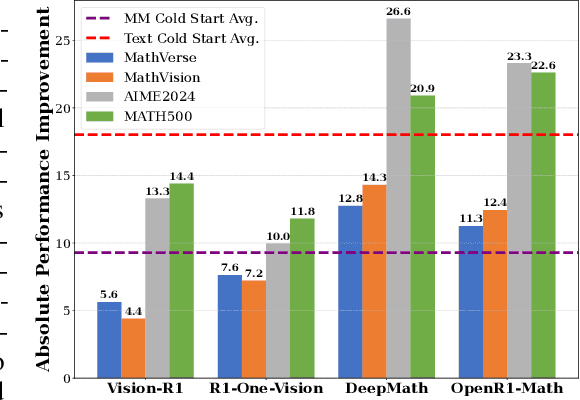
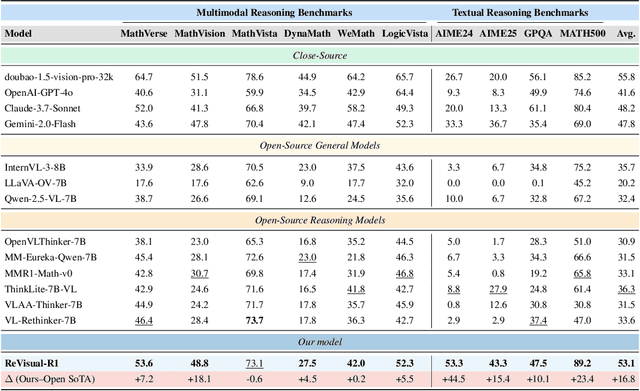
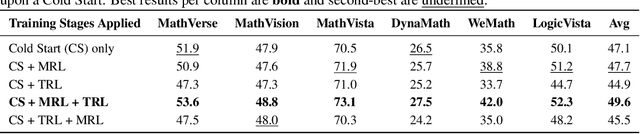
Inspired by the remarkable reasoning capabilities of Deepseek-R1 in complex textual tasks, many works attempt to incentivize similar capabilities in Multimodal Large Language Models (MLLMs) by directly applying reinforcement learning (RL). However, they still struggle to activate complex reasoning. In this paper, rather than examining multimodal RL in isolation, we delve into current training pipelines and identify three crucial phenomena: 1) Effective cold start initialization is critical for enhancing MLLM reasoning. Intriguingly, we find that initializing with carefully selected text data alone can lead to performance surpassing many recent multimodal reasoning models, even before multimodal RL. 2) Standard GRPO applied to multimodal RL suffers from gradient stagnation, which degrades training stability and performance. 3) Subsequent text-only RL training, following the multimodal RL phase, further enhances multimodal reasoning. This staged training approach effectively balances perceptual grounding and cognitive reasoning development. By incorporating the above insights and addressing multimodal RL issues, we introduce ReVisual-R1, achieving a new state-of-the-art among open-source 7B MLLMs on challenging benchmarks including MathVerse, MathVision, WeMath, LogicVista, DynaMath, and challenging AIME2024 and AIME2025.
AdaCtrl: Towards Adaptive and Controllable Reasoning via Difficulty-Aware Budgeting
May 24, 2025Modern large reasoning models demonstrate impressive problem-solving capabilities by employing sophisticated reasoning strategies. However, they often struggle to balance efficiency and effectiveness, frequently generating unnecessarily lengthy reasoning chains for simple problems. In this work, we propose AdaCtrl, a novel framework to support both difficulty-aware adaptive reasoning budget allocation and explicit user control over reasoning depth. AdaCtrl dynamically adjusts its reasoning length based on self-assessed problem difficulty, while also allowing users to manually control the budget to prioritize either efficiency or effectiveness. This is achieved through a two-stage training pipeline: an initial cold-start fine-tuning phase to instill the ability to self-aware difficulty and adjust reasoning budget, followed by a difficulty-aware reinforcement learning (RL) stage that refines the model's adaptive reasoning strategies and calibrates its difficulty assessments based on its evolving capabilities during online training. To enable intuitive user interaction, we design explicit length-triggered tags that function as a natural interface for budget control. Empirical results show that AdaCtrl adapts reasoning length based on estimated difficulty, compared to the standard training baseline that also incorporates fine-tuning and RL, it yields performance improvements and simultaneously reduces response length by 10.06% and 12.14% on the more challenging AIME2024 and AIME2025 datasets, which require elaborate reasoning, and by 62.05% and 91.04% on the MATH500 and GSM8K datasets, where more concise responses are sufficient. Furthermore, AdaCtrl enables precise user control over the reasoning budget, allowing for tailored responses to meet specific needs.